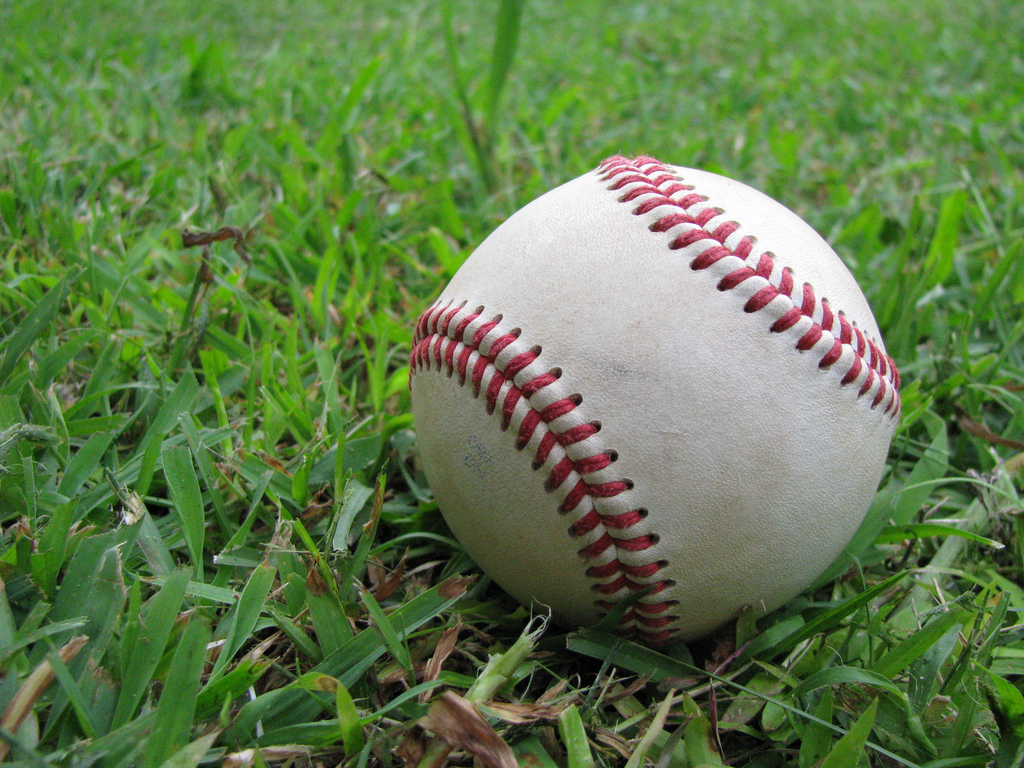
Today I heard the crack of a wooden baseball bat striking a ball. It resounded within the sauna walls (there I was again) echoing from the year 1955 as Charles told me how he had acquired a baseball from the 1955 World Series, a baseball signed by 23 New York Yankees’ players and manager Casey Stengel.
Champions in previous years, the Yankees had been expected to win the 1955 Series but lost to the Brooklyn Dodgers by a score of 4 – 3. Charles, though, came out a winner even though he was nowhere near Yankee Stadium in 1955.
Charles told me that as a newspaper reporter of sports he sometimes received gifts from folks he interviewed, folks grateful for his storytelling. In the mid-1970s one gift he received was box-seat tickets to a symphony performance. Now, Charles didn’t care much for orchestral music, but, nevertheless, he accepted the tickets from a local philanthropic insurance businessman, an aficionado of instrumental music.
A week before the symphony performance date for which Charles held tickets a psychologist whose office was in the same building as Charles’ office exclaimed during casual conversation, “What I wouldn’t give to have tickets to the symphony on Saturday!”
“Hmm,” Charles asked, “Well, what would you give? I have tickets to the symphony – box-seats.”
“What do you want to trade?” came the psychologist’s quick reply.
“That baseball rolling around in your drawer. The 1955 World Series baseball signed by the Yankees,” Charles answered.
“You’ve got it,” said the psychologist. “I told you that my uncle gave it to me thinking it would mean something to me because he was in the dugout during that Series. But it doesn’t mean anything to me. I didn’t like baseball as a kid and I don’t like it now.”
Charles told me that he protested the trade. He said he told the psychologist that the signed baseball was worth a whole lot more than box-seat tickets to the symphony.
“Not to me,” the psychologist answered.
That was the end of Charles’ story, except to say that he still has the baseball and that a similar ball recently sold for $2,300.00.
But I imagine the story continued for the psychologist. He might have anticipated hearing the concert music as excitedly as did Alexander Schimpf as recent guest pianist for the Yakima (WA) Symphony Orchestra Schimpf anticipated playing and hearing Beethoven’s Piano Concerto No. 5 in E-flat major, appropriately nicknamed The Emperor. “There … in the second movement, amidst the energy and optimism, the flourishes, harmonic shifts and a buoyant finale … will be the most beautiful melody you can imagine,” said Schimpf.
I must acknowledge that I’d like to be able to hear and describe orchestral music as Schimpf can but I cannot. I am not a student of music, rather, I’m simply a piano player of familiar hymns that are gracious enough within the beauty of singing voices to overlook my mistakes and omitted notes.
But it’s not true, either, that I appreciate the sounds of baseball more than the sounds of symphony. Baseball sounds are more familiar to me, though, baseball sounds from the sandlots of my youth where my father played with his brothers and other men during the 1940s. And baseball sounds I imagined as I recited Casey at the Bat by myself in elementary school, and, then, as part of a speaking chorus in high school.
I have no profound conclusion to this entry about listening. Perhaps, though, it is appropriate to suggest that when one listens closely one doesn’t have to be physically present to the sound one hears. To suggest that sound travels through history?


